Blog Post
Cognitive Load in Online Learning: How to Design for Better Outcomes

Cognitive Load in Online Learning: How to Design for Better Outcomes
Think about the last time you tried to learn something online and gave up halfway through. Odds are it wasn't because the content was too difficult; it was because the experience of consuming it was exhausting. A wall of text here. A cluttered interface there. No clear sense of where you were or what came next. Before you knew it, your brain was running empty, and no real learning had taken place.
This phenomenon has a name: cognitive overload. And in the world of online learning, especially asynchronous environments where there's no instructor to guide, pace, or reassure, it's one of the biggest barriers standing between a learner and genuine comprehension. Understanding it is the first step. Designing against it is the goal.
What Is Cognitive Load Theory?
In 1988, Australian educational psychologist John Sweller published a landmark study titled Cognitive Load During Problem Solving: Effects on Learning in the journal Cognitive Science. Studying learners as they solved problems, Sweller and his colleagues found something counterintuitive: conventional problem-solving methods weren't always effective for learning. The reason? They placed too much demand on working memory.
Sweller built his theory on a critical insight borrowed from cognitive psychologist George Miller: working memory is severely limited, capable of holding only a small number of elements at any one time. Long-term memory, by contrast, stores rich, organized structures called schemas, the building blocks of genuine expertise. The goal of any good instructional design, Sweller argued, is to support the construction of those schemas without overwhelming the working memory that must process new information first.
Sweller's key finding: conventional goal-directed problem solving (means-ends analysis) frequently prevented schema acquisition, because the cognitive load of managing subgoals left nothing available for actual learning. Worked examples, by contrast, consistently outperformed open-ended problem solving for novice learners, a finding that has since been replicated across subjects and contexts.

The Three Types of Cognitive Load
CLT distinguishes three distinct load types. Knowing which kind you're creating is the first step in designing against overload:
- Intrinsic Load: the inherent difficulty of the content itself. You can't eliminate it, but you can scaffold it.
- Extraneous Load: load caused by poor design: cluttered layouts, confusing navigation, irrelevant information. This is the enemy. It consumes working memory without contributing to learning.
- Germane Load: the mental effort devoted to forming and automating schemas. This is the "good" load. Well-designed instruction maximizes it by freeing cognitive resources from extraneous demands.
The practical implication is direct: minimize extraneous load, manage intrinsic load through scaffolding, and create conditions where germane load, the productive kind, can dominate.
Why It Matters Especially in Online Learning
Cognitive load theory was born in the context of classroom-based problem-solving, but its implications are even more pronounced in digital learning environments.
A 2025 meta-analysis published in Frontiers in Psychology confirmed what many educators intuitively suspected: analyzing 63 studies across 124,166 students in 28 countries, it found a statistically significant negative association between unmanaged technology-related factors and academic performance [Q(64) = 2501.93, p < 0.001]. Technology-related factors, including interface design and information delivery methods, have a measurable and significant impact on students' academic performance in online environments. The design is the instruction, in ways that are simply not true in face-to-face settings.
The result: when a learner is simultaneously navigating an unfamiliar platform, interpreting poorly organized content, managing their own attention, and trying to absorb new material, cognitive overload isn't a risk. It's a near certainty.
Common culprits include:
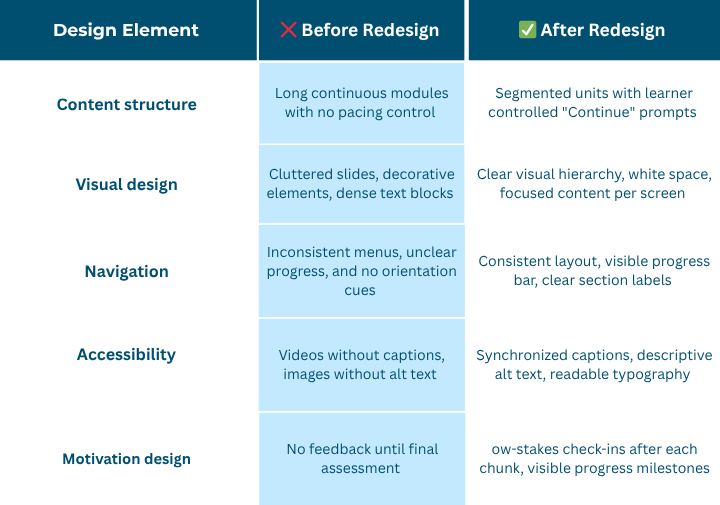
- Cluttered UI: too many visual elements force learners to spend cognitive resources interpreting the interface rather than the content
- Poor navigation: confusion about "Where am I? What's next?" is a form of extraneous load that compounds with every unclear click
- Information density: walls of text, slide-packed bullet points, and long unbroken videos exceed working memory capacity and trigger disengagement
Design Principles to Reduce Overload
One of the most well-supported applications of CLT is chunking, breaking complex content into smaller, meaningful, and logically sequenced units. The concept traces to Miller's (1956) law: working memory reliably handles only a limited number of units at a time.
Crucially, chunking isn't just cutting text into shorter pieces. It's about organizing information into related, logical, and sequential segments, each complete and building toward the next.
The outcomes are measurable:
- 20–30% Improvement in retention when content is properly chunked and segmented
- 32% Enhancement in task accomplishment rates with cognitive load-optimized course design
- 23% Average decrease in cognitive load across learner types with smart course restructuring
Accessibility & Mobile Learning
Accessibility is often framed as a legal obligation. From a cognitive load perspective, it's also a universal design choice that benefits all learners. Accurate, synchronized captions reduce the effort required to parse audio content. Clear typographic hierarchy allows learners to navigate content structurally rather than reading every word to orient themselves. Research reviewed by Frontiers in Education confirms that inaccurate captions and poorly synchronized transcripts increase perceived cognitive load by forcing learners to decode rather than receive information.
Every accessibility feature that removes a comprehension barrier is simultaneously a cognitive load reduction strategy. They are not separate concerns.
What Redesign Actually Looks Like
The most compelling evidence for CLT-informed design comes from courses deliberately redesigned with these principles, and the outcomes are consistent: reduced extraneous load, improved segmentation, and learner-controlled pacing produce measurable gains in comprehension, retention, and completion.
The Design Is the Instruction
Cognitive overload is a design failure, not a learner's deficiency. Sweller’s original insight remains vital: cluttered interfaces and unbroken content actively block schema formation by fighting the brain’s natural limits.
By applying the three-part framework, minimizing extraneous noise, scaffolding intrinsic complexity, and protecting germane processing, designers can improve retention by up to 30%. Ultimately, students in online environments struggle not because the material is too difficult, but because the experience of consuming it is exhausting. Fix the design, and you fix the learning.
EDUTECHLoft for Smarter Course Design for Better Learning Outcomes
|
When learners struggle, it’s often not the content; it’s the experience. Our EDUTECHLoft Design® turns your ideas into learner-centered, technology-driven programs that reduce cognitive overload, improve engagement, and drive measurable learning outcomes. For more information on how we can help you, schedule a meeting with us and discover how we can help your institution grow! |