Blog Post
Harnessing AI: Transforming Marketing Strategies in Higher Education

Harnessing AI: Transforming Marketing Strategies in Higher Education
Harnessing AI: Transforming Marketing Strategies in Higher Education
In today’s rapidly evolving digital landscape, higher education institutions are searching for innovative ways to attract, engage, and enroll students. At the center of this transformation is artificial intelligence (AI). AI is reshaping how institutions communicate with prospective students, personalize content, optimize marketing campaigns, and forecast enrollment trends.
This article explores:
- How AI-powered personalization improves engagement and conversion
- How predictive analytics strengthens recruitment forecasting
- The operational and financial impact of AI chatbots
- How generative AI search is reshaping SEO strategies
- Why governance and ethics must guide AI adoption in higher ed
Hyper-Personalization: Driving Engagement and Conversion
AI allows institutions to move beyond demographic-based targeting and instead respond to real-time behaviors, interests, and intent. This shift empowers marketing teams to deliver highly relevant content that resonates with prospective students — ultimately increasing engagement and conversions.

What the Research Shows
Studies confirm a direct, causal relationship:
- AI-powered personalization increases student engagement.
- Higher engagement leads to improved application and enrollment outcomes.
Importantly, AI’s value comes not from sending more messages, but from improving the quality of interactions. Key drivers of engagement include:
- Personalization
- Interactivity
- Responsiveness
Why This Improves Conversion
Personalized campaigns make students feel “seen,” increasing the likelihood that they inquire, apply, and ultimately enroll. AI also plays a vital role in emotional support:
- 90% of students expect fast responses.
- Quick, personalized feedback reduces frustration, builds early trust, and meets emotional needs during an often stressful enrollment journey.
By creating smoother interactions and delivering timely support, AI helps institutions ease concerns and strengthen student confidence. On a broader scale, AI-powered marketing aligns with the modern campus experience, reinforcing institutional credibility and demonstrating a commitment to innovation.
Predictive Intelligence and Enrollment Forecasting
AI-driven predictive analytics enables institutions to move away from retrospective, spreadsheet-based forecasting and toward proactive, real-time strategy.

Why Traditional Forecasting No Longer Works
For decades, enrollment teams relied on historical yield, past demographics, and static models — approaches that struggle to keep up with:
- Shifting student behaviors
- Rapid changes in digital engagement
- Unpredictable enrollment patterns
Relying exclusively on old models now poses operational risk.
How AI Improves Predictive Modeling
AI aggregates and analyzes large, diverse data sets — including engagement metrics, academic history, program interactions, location, and more — to:
- Identify which students are likely to apply or enroll
- Spot early signs of risk or disengagement
- Provide actionable insights in real time
From 2020 to 2025, higher ed saw rapid adoption of multi-phase predictive models to better predict outcomes such as retention and dropout.
Key Use Cases Where Predictive Analytics Makes a Difference
1. Yield Forecasting
By analyzing digital behaviors and engagement intensity, predictive models reveal which admitted students are most likely to enroll.
This enables teams to:
- Prioritize phone calls
- Deliver tailored communication
- Allocate financial aid strategically
The result: higher yield with fewer wasted resources.
2. Marketing Funnel Optimization
AI identifies:
- Which emails, social posts, or landing pages drive movement
- Which regions engage more deeply
- Which content themes resonate
This shifts marketing from “broad outreach” to truly intent-based communication.
3. Summer Melt Prevention
AI monitors login patterns, event attendance, and engagement signals to detect early warning signs that a student may slip away. This allows teams to intervene before melt occurs — improving enrollment stability.
Conversational AI: Modernizing Student Support and Recruitment
Conversational AI, powered by natural language processing (NLP) and machine learning, offers a scalable way to deliver personalized support throughout the recruitment journey.
What Conversational AI Does Well
Chatbots can:
- Answer common admissions and financial aid questions
- Provide 24/7 support
- Reduce staff workload
- Improve speed-to-respond — a key driver of conversion
- Create a sense of connection early in the inquiry process
Financial Impact and ROI
Beyond efficiency, conversational AI has measurable financial benefits.
- A hypothetical financial model shows:
- A 1% increase in enrollment and retention driven by improved customer experience
- Results in an estimated 4,158% ROI for the chatbot
- Every $1 invested could return $41.58 in revenue
The takeaway: small lifts in conversion or melt prevention create massive downstream impact.
Limitations: Where Human Staff Are Still Essential
However, research shows:
- AI provides strong cognitive support (facts, processes)
- But is weaker at emotional or motivational support
Therefore, AI should complement—not replace—human staff. High-stakes or emotionally sensitive moments still require human connection.
Improving Chatbot Interactions
Institutions should analyze:
- Opt-out patterns
- Unanswered questions
- Conversation drop-off points
A student exiting a chat does not necessarily mean their question was resolved; it may indicate frustration or confusion. Enhancing the chatbot’s interface and knowledge base is critical for meaningful engagement and future conversion.
The Generative Search Revolution and Its SEO Implications
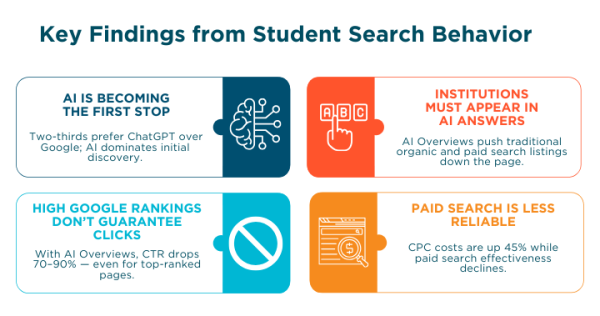
AI-powered search tools — including Google’s Search Generative Experience (SGE), Gemini, and ChatGPT — represent the most significant shift in online discovery in 20 years.
The New Reality of Zero-Click Search
Prospective students increasingly prefer AI platforms for information gathering:
- 50% use AI tools weekly
- 24% use them daily
- Younger audiences start their search in AI tools, not Google
If institutional content isn’t optimized for AI retrieval, it may become invisible.
How Institutions Can Adapt
Success now requires:
- Producing authoritative, deep, structured content
- Optimizing for AI understanding, not just keyword placement
- Creating content that answers complex, conversational questions
- Ensuring program pages reflect expertise and trustworthiness
- Using structured data and schema markup
In this new environment, institutions must prioritize AI-ready content over traditional SEO tactics.
Governance, Ethics, and Responsible AI Adoption
Effective AI governance in higher education requires a forward-thinking, ethical, and risk-based approach.
Why Governance Matters
Over half of prospective students expect transparency about AI usage. Institutions must demonstrate responsible use of data and algorithms to build trust.
Key governance concerns include:
- Data privacy
- Algorithmic bias
- Educational equity
- Academic honesty
- Institutional integrity
Risk-Based Governance Models
Institutions should categorize AI tools according to risk level:
- Low-risk: chatbots
- Medium-risk: marketing personalization tools
- High-risk: predictive models influencing admissions or retention
Each level requires different monitoring, documentation, and human oversight.
Impact on Academic and Organizational Culture
Faculty adoption of AI is increasing, but concerns remain around:
- Bias
- Transparency
- Fair use
- Academic integrity
Cross-department teams involving marketing, IT, student success, academic leaders, and data privacy professionals should oversee responsible deployment.
This cohesive approach minimizes reputational risk and ensures AI is implemented ethically, consistently, and in alignment with institutional values.
Conclusion
|
AI is not a passing trend — it is a transformative force revolutionizing how higher education institutions attract, engage, and enroll students. By embracing AI for personalization, predictive analytics, conversational engagement, and search optimization, colleges and universities can enhance their competitiveness and deliver meaningful value to prospective students. Leaders who begin piloting, experimenting, and governing AI now will be best positioned to thrive in an increasingly complex and rapidly evolving enrollment landscape. If you're looking for support, guidance, or simply want to explore solutions tailored to your institution’s needs, EDUTECHLoft is here to help. Book a meeting with us today, and let’s talk about how we can move your goals forward. |