Blog Post
Measuring Marketing ROI in Higher Education: Frameworks and Techniques

Measuring Marketing ROI in Higher Education: Frameworks and Techniques
Measuring Marketing ROI in Higher Education: Frameworks and Techniques
Higher education is entering a period where every major decision, from adopting AI tools to adjusting advising models, must have a clear impact. Declining enrollment, rising costs, and higher student expectations mean institutions can no longer rely on intuition or annual reports alone.
Looking ahead to 2026, the key question is no longer “Did we launch the initiative?” Instead, leaders are asking: “What measurable value did this initiative create, and who did it benefit?”
This blog will help teams understand:
- Why tracking the right enrollment, marketing, and retention metrics is essential for improving ROI and student outcomes.
- How brand awareness and trust improve marketing efficiency and ROI.
- How academic quality and student experience drive long-term institutional value.
- How institutions can standardize, measure, and act on ROI using clear indicators, practical workflows, and financially grounded formulas.
Why ROI Measurement Matters More Than Ever in Higher Education
1. Enrollment Challenges Require Evidence, Not Guesswork
Demographic shifts and increased competition, especially from online and non-traditional providers, mean universities must evaluate which channels, programs, and initiatives truly drive enrollment.
ROI measurement helps institutions:
- Identify which marketing channels attract high-quality prospects.
- Focus on resources on strategies that improve yield, not just visibility.
- Defend budget decisions with data that leadership can trust.

2. Real Metrics must guide marketing & Recruitment
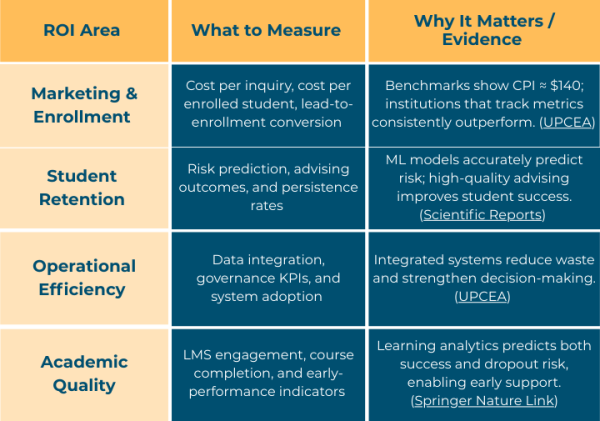
Industry research shows that many institutions still lack consistent measurement. Fewer than half of higher education marketing teams track core metrics such as cost per inquiry (CPI) or cost per enrolled student.
For teams that do measure performance, benchmarks are valuable. The average CPI across higher education is approximately $140. Knowing this allows institutions to compare performance, optimize spending, and identify campaigns that contribute directly to enrollment growth rather than surface-level engagement.
3. Student Retention & Success: A High-Impact ROI Driver
ROI does not end when a student enrolls. Retaining students and supporting their success has major academic and financial implications.
Research consistently shows that students who receive meaningful advising develop stronger study habits, higher confidence, and better persistence outcomes. At the same time, predictive analytics and machine learning models are increasingly effective at identifying students at risk of dropping out.
Retention is no longer a “soft” outcome. It is measurable, trackable, and directly tied to institutional sustainability.
The Role of Brand Equity in the ROI Equation
Most ROI discussions in higher education focus on mid-funnel metrics such as cost per inquiry (CPI), cost per enrolled student, or persistence rates. While these indicators are essential, they do not capture the value of a strong institutional brand.
Brand strength influences the entire funnel. When prospective students already recognize and trust an institution, marketing campaigns become more efficient and acquisition costs decline over time.
To measure this long-term impact, institutions can include brand-focused indicators in their ROI framework, such as:
- Brand Lift Studies: Which track changes in familiarity, favorability, or likelihood to consider after campaign exposure.
- Unaided and Aided Awareness: Measured consistently across key audiences.
- Branded Search Volume: Which signals growing demand and market interest.
These indicators help institutions understand how awareness campaigns, thought leadership, and reputation-building efforts contribute to lower CPI, stronger yield, and improved long-term performance.
Key ROI Pillars Universities Should Measure in 2026
Pillar 1: Marketing Performance & Enrollment Efficiency
Tracking metrics such as CPI, cost per enrolled student, and lead-to-enrollment conversion provides a clear view of marketing effectiveness. Benchmarks help teams evaluate whether performance is improving or declining over time.
Moving Toward Fully Loaded Cost Per Enrollment (FLCPE)
Many teams calculate acquisition costs using only media spend. While useful, this approach often underestimates the actual cost of enrolling a student.
Fully Loaded Cost Per Enrollment (FLCPE) offers a more complete view by including:
- Media and campaign spending
- Agency and creative fees
- CRM and marketing automation tools
- Enrollment and recruitment staff time
- Related overhead costs
Using FLCPE allows institutions to compare programs accurately, plan budgets more effectively, and present ROI in terms that resonate with financial leadership.
Pillar 2: Student Retention & Success Through Early Intervention
Predictive analytics and machine learning can identify at-risk students early, allowing institutions to intervene before challenges escalate. When paired with strong advising practices, these insights significantly improve persistence and completion rates.
Predictive Analytics for Marketing & Enrollment ROI
Predictive models can also improve the front end of the enrollment funnel.
1. Lead Scoring models (Applicant Propensity Modeling)
Estimate which inquiries are most likely to apply, helping teams prioritize outreach and reduce wasted effort.
2. Yield Propensity Modeling
Predict which applicants are most likely to enroll, allowing admissions teams to focus events, advising, and financial aid conversations on high-value prospects.
By directing human-intensive resources to students most likely to convert, institutions improve efficiency without increasing staff or spending.
Pillar 3: Operational & Data Efficiency
Institutions with integrated systems, CRM, SIS, LMS, and analytics, make faster and more accurate decisions. Clear data governance reduces duplication, improves reporting, and aligns teams around shared goals.
Operational efficiency directly supports ROI by minimizing waste and enabling coordinated action across marketing, enrollment, and student success.
Pillar 4: Academic Quality & Student Experience
Long-term ROI depends on academic outcomes. Measuring course engagement, LMS activity, and completion rates helps institutions understand educational impact and identify opportunities for improvement.
Learning analytics, especially when combined with predictive models, support personalized interventions that improve both student experience and institutional outcomes.
Strategic ROI Indicators for University Teams (2026)
Practical Tips to Strengthen ROI Measurement in 2026
- Build a Unified Data: Across marketing, enrollment, and student success to track impact across the full student lifecycle.
- Use multi-touch attribution models: To better reflect long decision cycles in higher education.
- Set Program-Level Benchmarks: Since ROI varies widely across disciplines.
- Focus on high-intent metrics: Such as form submissions, event attendance, and advising interaction.
- Operationalize predictive analytics: By embedding insights into advising and enrollment workflows.
- Create shared dashboards: So cross-functional teams work from the same data.
- Conduct quarterly ROI reviews: To identify issues early and adjust strategy.

Standardizing the Marketing ROI Formula
To align marketing performance with institutional finance, universities need a clear and consistent ROI model.
A practical approach is Marketing Return on Investment (MROI), calculated using student lifetime value and acquisition cost.
- Lifetime Value (LTV): Net tuition revenue per student, adjusted for predicted retention.
- Cost of Acquisition (COA): Ideally measured using FLCPE rather than media spend alone.
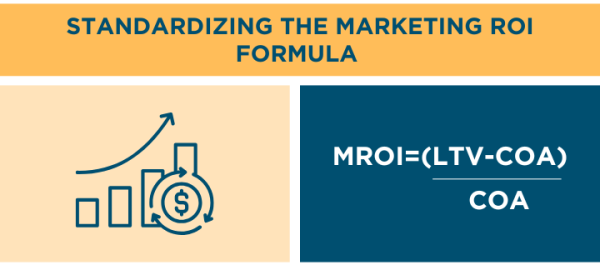
This formula allows marketing teams to communicate impact in financial terms that are easy for provosts, CFOs, and cabinet leaders to understand.
Final Thoughts
|
To remain competitive and student-centered in 2026, universities must move beyond intuition and adopt a rigorous, data-driven approach to ROI. Measuring impact across marketing, retention, operations, and academic quality enables institutions to make smarter investments, support students more effectively, and ensure long-term sustainability. For more information on how we can help you, schedule a meeting with us or contact us at info@edutechloft.com. |