Blog Post
Navigating Social Media Platforms for University Branding Success

Navigating Social Media Platforms for University Branding Success
Navigating Social Media Platforms for University Branding Success
Social media has become one of the most powerful tools universities use to shape visibility, perception, and student decision-making. According to recent student surveys, platforms like Instagram, TikTok, and YouTube now hold significant influence during early university discovery phases, with 57% of prospective students using these channels to research institutions.
While central marketing teams manage the institution’s primary brand identity, department-level accounts (or schools such as Business, Engineering, or Medicine) play a different – and increasingly essential role: adding depth, academic relevance, and authenticity to the university’s overall digital presence.
You’ll learn:
- Why department-level content strengthens brand trust and differentiation.
- How to align with central marketing without losing identity,
- Platform-specific strategies for high-impact content.
- A cross-functional workflow for coordinated execution.
- What metrics department teams should track.
- Future-focused trends shaping higher education marketing in 2026 and beyond.
The Core Challenge: Departments Struggle to Stand Out Consistently
Most universities rely on central marketing teams to manage top-level identity, leading departments to ask a critical question:
How do we tell our department program-specific stories without conflicting with the university brand?
Departments face unique challenges:
- Limited visibility on institutional channels.
- Highly specialized content that central teams cannot always communicate.
- A need for consistent output, often with smaller teams.
- Balancing program identity with overarching brand guidelines.
The Department Advantage: Academic Depth, Expertise & Authenticity
School teams have access to stories central marketing cannot replicate — real research, specialized knowledge, hands-on learning, student achievements, and community impact. This content is:
- Academically rich.
- Credible.
- Specific to each discipline.
- Closely connected to student experience.
Why This Matters for Reputation & Recruitment
When executed strategically, department-level content strengthens the university’s digital reputation by:
- Showcasing real learning environments.
- Increasing authenticity and credibility.
- Helping students visualize themselves in the program.
- Attracting industry partners and research collaborators.
Department and central marketing work best together — not separately — to bring the full academic story to life.
Aligning With the University Brand Without Losing Faculty Identity
As Donna Lehmann notes, even when teams were sharing similar information, inconsistencies in color, layout, and visual style made the web pages feel disconnected from the overall university brand.
Consistent department-level storytelling requires a coordinated approach that reinforces institutional messages while highlighting each program's unique strengths. To achieve this balance, teams should:
- Understand central priorities and upcoming campaigns.
- Identify content opportunities only the faculty can produce.
- Coordinate drafts and visuals for brand consistency.
- Adapt stories to the right platforms based on audience behavior.
This alignment creates a multi-layered brand presence: central marketing builds awareness, while departments build trust and depth.
Platform-Specific Content Strategies
Different platforms serve different audience needs. Teams maximize impact when they tailor content to each channel’s strengths.

TikTok & Instagram Reels (Prospective Students / Gen Z)
Effective content includes:
- Student-led videos showing labs, studios, or events.
- “Day in the life” stories.
- Trend-based formats infused with academic elements.
Why it works: Short-form video boosts reach and engagement among Gen Z, and student-generated content drives significantly higher interaction.
LinkedIn (Professionals, Alumni, Prospective Grad Students)
High-performing formats include:
- Research impact stories.
- Program outcomes.
- Industry collaborations.
- Alumni success features.
Why it works: LinkedIn strengthens academic authority and builds professional credibility through thought leadership.
YouTube (Global Reach & Evergreen Content)
Ideal for:
- Program explainers.
- Faculty lectures or Q&A sessions.
- VR-style campus experiences.
- Alumni interviews.
Why it works: YouTube supports long-form storytelling and remains a powerful discovery engine for prospective students.
While departments drive content strategy, individual professors can also amplify programs when appropriate. For example:
Nicole Ellison, Professor at the University of Michigan School of Information, shares research insights and digital behavior trends on social media, highlighting the academic expertise within her department. This serves as a complementary example of how professors can extend a department’s reach authentically.
Incorporating UGC and Student Influencers
Authenticity remains a top driver for student audiences. Research shows that nearly 81% of consumers trust UGC content more than branded content.
By empowering ambassadors to share real experiences, department teams can:
- Boost credibility.
- Amplify reach.
- Increase engagement.
- Attract like-minded prospects.
Student voices remain one of the most influential assets in the recruitment pipeline.

Ownership Matrix: Who Owns What?
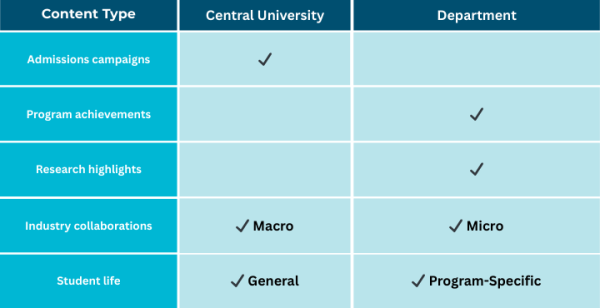
This structure ensures clarity, reduces duplication, and creates a cohesive brand ecosystem.
A Coordinated Workflow for Department + Central Marketing Teams
Although not a weekly checklist, a strategic workflow helps both teams stay aligned:
- Review institutional priorities. Faculties understand upcoming central campaigns to support — not duplicate — them.
- Identify faculty-owned content. Research, academic projects, program news, and student showcases.
- Share drafts and visuals for brand alignment. Ensures tone, quality, and visual consistency.
- Publish with platform purpose. Use Instagram, TikTok, LinkedIn, YouTube, and X selectively, based on audience and story type.
- Use analytics as a feedback loop. Evaluate trends in engagement quality, video completion rates, and traffic to program pages.
This workflow keeps both teams coordinated without rigid posting schedules.
Measuring What Really Matters
Instead of focusing on vanity metrics, department teams benefit from measuring indicators that reflect academic value and recruitment impact.
Key KPIs Include:
- High-intent traffic to program pages
- Quality engagement (comments, saves, shares).
- Alumni & industry interaction.
- Video completion rates.
- UGC amplification.
These insights reveal which content supports recruitment, strengthens credibility, and enhances brand reputation.
For a deeper dive into how universities can calculate CPI, CPE, and overall marketing ROI, see our full breakdown of ROI measurement in higher education.
Future-Focused Insights for 2026 and Beyond
As digital behavior evolves, institutions must adopt modern practices that keep pace with student expectations.
2026 Trends Shaping Higher Ed Marketing
- Rise of micro-communities: More conversational, niche engagement across Instagram, TikTok, LinkedIn, and YouTube.
- AI-driven personalization: Tailored messaging for prospects, students, alumni, and faculty without increasing workload.
- Immersive content experiences: Virtual walk-throughs, interactive videos, and AR-enhanced storytelling.
- UGC as a recruitment driver: Student-led content continues to outperform institutional posts for authenticity and relatability.
These trends signal a shift toward authenticity, interactivity, and experience-driven communication.
Final thoughts
|
Social media is no longer optional for school marketing teams — it’s a strategic tool that strengthens academic reputation, recruitment outcomes, and institutional credibility by: 1. Producing authentic, specialized content. 2. Coordinating efficiently with central marketing. 3. Measuring meaningful, audience-focused metrics. Teams can amplify the university brand and build digital communities that reflect real program identity. As the landscape evolves, teams are uniquely positioned to lead with storytelling that is credible, human, and academically meaningful. For more information on how we can help you, schedule a meeting with us or contact us at info@edutechloft.com. |