Blog Post
Operational Alignment in Higher Ed: Why Departments Can’t Work in Silos Anymore

Operational Alignment in Higher Ed: Why Departments Can’t Work in Silos Anymore
Operational Alignment in Higher Ed: Why Departments Can’t Work in Silos Anymore
Higher education institutions operate in an environment defined by rapid change: evolving student expectations, new delivery models, intensifying competition, and heightened pressure to demonstrate outcomes. In this context, operational alignment is no longer a “nice to have”, it is foundational to institutional effectiveness and student success.
Yet many institutions still operate through deeply siloed structures. Academic affairs, enrollment management, IT, and student services often function independently, each optimizing its own goals, systems, and timelines. Sector research consistently shows that this fragmentation limits agility, creates inefficiencies, and weakens the student experience.
To move forward, institutions must rethink how departments collaborate, not by adding more layers of coordination, but by intentionally aligning strategy, data, and operations around shared outcomes.
Today we will cover:
- Why traditional departmental silos persist in higher education, and why they are increasingly unsustainabl
- How misalignment across academic affairs, enrollment, IT, and student services impacts the full student lifecycle
- Where operational breakdowns most often occur during program launches, enrollment growth, and digital transformation
- What operational alignment looks like in practice (beyond org charts and committees)
- Practical first steps institutions can take to move toward a more connected, collaborative model
The Silo Problem in Higher Education
Silos in higher education are rarely intentional. They are often the result of historical governance models, decentralized decision-making, and disconnected systems that evolved over time. Each department develops its own processes, tools, and metrics, making cross-functional collaboration difficult even when institutional goals are aligned.
The Connected College framework emphasizes that without intentional coordination across services and systems, institutions accumulate complexity that slows execution and reduces impact.

How Silos Impact the Student Lifecycle
From a student’s perspective, institutional silos are invisible, but their effects are not.
When departments operate independently, students often experience inconsistent information, delayed support, and gaps between recruitment promises and academic reality. These breakdowns typically appear at transition points such as inquiry-to-enrollment or enrollment-to-advising.
Research on academic operations and student success shows that fragmented workflows and unclear ownership directly affect persistence and completion outcomes
Operational alignment ensures that departments are not simply performing their individual functions well but contributing to a cohesive end-to-end student experience.
Academic Affairs and Enrollment: Aligning Promise With Reality
One of the most critical alignment points in higher education is between academic affairs and enrollment teams.
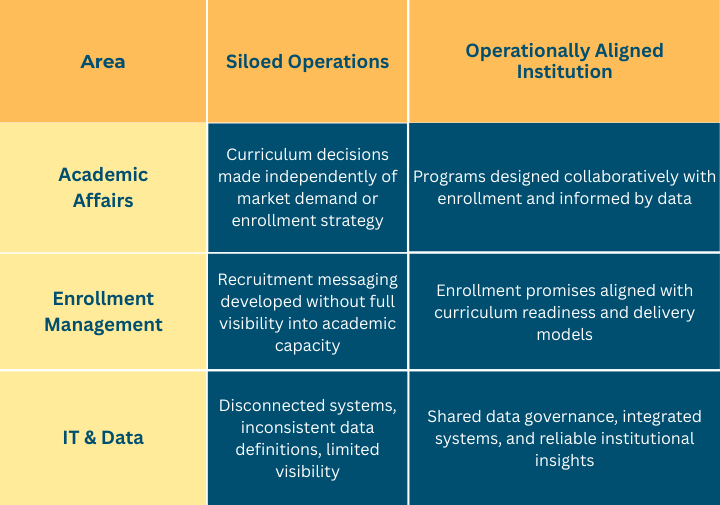
Enrollment strategies often depend on program differentiation, modality, and career outcomes. However, when academic capacity, curriculum design, or delivery timelines are not fully aligned with recruitment messaging, institutions risk overpromising or misrepresenting the student experience.
Cross-departmental collaboration allows institutions to:
- Validate program readiness before launch
- Align messaging with academic delivery
- Coordinate timelines for curriculum approval, staffing, and accreditation
When these functions operate in silos, institutions risk overpromising or launching programs without adequate readiness. Cross-departmental collaboration helps ensure that enrollment strategies are grounded in academic feasibility and long-term sustainability, a dynamic highlighted in research on departmental collaboration and enrollment performance.
Academic Affairs and IT: The Infrastructure of Modern Learning
Technology is no longer a support function, it is core academic infrastructure. Learning management systems, analytics platforms, and scheduling tools shape how teaching and learning occur.
However, when IT and academic affairs are not aligned, institutions often face fragmented systems and unreliable data. Effective data governance enables consistent definitions, shared visibility, and better decision-making across departments.
Operational alignment between academic and technical teams ensures that systems support real academic workflows, not just technical efficiency.

Student Services: An Essential Partner in Student Success
Student services teams, advising, tutoring, accessibility, career services, are often brought into planning after programs are already live. This reactive involvement can create capacity issues and limit the effectiveness of support structures.
Operational alignment ensures student services are part of strategic planning from the start. When these teams are included early:
- Support capacity aligns with enrollment growth
- Advising models reflect program complexity
- Students receive consistent guidance throughout their journey
Academic operations research consistently links coordinated support services to improved retention and completion outcomes.
How Silos vs. Operational Alignment Show Up in Practice
The Real Cost of Misalignment
The cost of silos extends far beyond inefficiency. Misalignment leads to:
- Slower program launches
- Duplicated effort across teams
- Staff burnout caused by constant workarounds
- Inconsistent data and unclear performance metrics
Perhaps most importantly, it limits an institution’s ability to understand what is working and why. Without shared benchmarks and operational clarity, leadership lacks the visibility needed to make informed, strategic decisions.
Aligning operations allows institutions to shift from reactive problem-solving to proactive planning.
What Operational Alignment Looks Like in Practice
Operational alignment does not require centralized control or excessive meetings. Instead, it relies on a few core principles:
- Shared goals: Departments align around student success, program quality, and institutional sustainability.
- Clear ownership: Roles and responsibilities are defined across functions to reduce ambiguity.
- Connected systems: Data flows across departments using consistent definitions and governance.
- Cross-functional planning: Major initiatives involve academic, administrative, and technical stakeholders from the outset.
This approach reflects a connected-college model, where coordination enables autonomy rather than restricting it.
First Steps Institutions Can Take Today
Institutions do not need to overhaul their entire structure to improve alignment. Practical first steps include:
- Mapping one student journey across departments to identify friction points
- Establishing shared KPIs across two or three core functions
- Creating cross-functional working groups for high-impact initiatives
- Reviewing data definitions to ensure consistency across systems
Small, intentional changes can unlock significant gains in efficiency, clarity, and collaboration.
Final Thoughts
|
Higher education institutions are too complex, and student expectations too high, for departments to operate in isolation. Operational alignment is no longer about efficiency alone; it is about delivering on institutional promises, supporting student success, and enabling sustainable growth. When academic affairs, enrollment, IT, and student services work together through shared strategy, data, and processes, institutions move faster, operate smarter, and serve students more effectively. Breaking down silos is not a cultural shift alone, it is an operational imperative. For more information on how we can help you, schedule a meeting with us or contact us at info@edutechloft.com. |