Blog Post
Supporting the Support Teams: Operational Strategies That Reduce Staff Burnout

Supporting the Support Teams: Operational Strategies That Reduce Staff Burnout
Supporting the Support Teams: Operational Strategies That Reduce Staff Burnout
Higher education support teams are operating under growing pressure. Rising student expectations, increasingly complex systems, and persistent resource constraints have transformed roles in admissions, advising, student services, and academic operations.
Burnout is no longer an isolated or personal issue. It has become an operational risk.
Today we will cover:
- Why burnout in higher education is fundamentally a systems problem.
- How clearer processes and better-aligned systems reduce cognitive and emotional strain.
- Why realistic capacity planning is essential for morale and sustainability.
- How people-centered operations strengthen long-term institutional resilience.
Why Burnout Must Be Addressed at the Operational Level
- Burnout Is an Occupational Phenomenon, not a Personal Failure
The World Health Organization classifies burnout as an occupational phenomenon, defined by chronic workplace stress that has not been successfully managed. This framing is critical. Burnout is not about individual resilience or motivation, it is about how work is structured.
Research consistently shows that when burnout appears at scale, the underlying causes are organizational: excessive workload, lack of control, unclear expectations, and misaligned systems.
Treating burnout as a personal issue obscures the real drivers and delays meaningful change.
- Support Teams Are Absorbing Institutional Complexity
Support teams often serve as the interface between students and institutional systems. When processes are unclear or systems are fragmented, staff absorb that complexity on behalf of students.
This reality shows up as:
- Constant context switching between platforms.
- Manual workarounds to compensate for disconnected systems.
- Emotional labor from managing frustration, confusion, and escalation.
- Peak-cycle overload during enrollment, registration, and term launches.
Research on workforce burnout in knowledge-intensive environments shows that chronic overload, ambiguity, and emotional demands are powerful predictors of exhaustion and disengagement.
Over time, these conditions erode morale, even among highly mission-driven staff.

Clear Processes Reduce Cognitive Load
- Process Clarity as a Burnout Prevention Strategy
Unclear or undocumented processes increase cognitive load. When staff must repeatedly decide how to handle routine issues, mental energy is depleted before meaningful work begins.
Service design and operational case studies consistently show that clarity improves performance and wellbeing by reducing unnecessary decision-making.
Clear processes help by:
- Defining ownership and escalation paths
- Reducing decision fatigue in high-volume environments
- Supporting faster onboarding and knowledge transfer
- Minimizing errors and rework
Well-designed workflows allow staff to focus on students, not on navigating ambiguity.
Better Systems = Less Emotional Labor
- When Technology Transfers Stress Instead of Absorbing It
Technology is often introduced to improve efficiency, but when systems are poorly aligned, they can increase emotional and cognitive strain instead. In these cases, complexity is not removed, it is passed directly to staff.
Consider a common scenario: a CRM does not fully sync with the Student Information System. A support staff member must manually copy data from one platform to another while a frustrated student waits on the phone. The system is not absorbing complexity; it is transferring stress in real time to both the employee and the student.
Research on emotional labor shows that roles requiring sustained interpersonal engagement become significantly more exhausting when staff must compensate for system failures through manual workarounds and emotional regulation. Over time, this invisible labor accelerates burnout.
Research on emotional labor shows that roles requiring sustained interpersonal engagement become significantly more taxing when systems fail to support the work itself.
People-centered systems share key characteristics:
- A single source of truth
- Automation for repetitive, low-judgment tasks
- Visibility into workload and case status
- Fewer, better-integrated tools
When systems absorb complexity, staff energy is preserved for meaningful human interaction.
Capacity Planning That Respects Reality
- Why Headcount Alone Is Not Capacity
One of the most common contributions to burnout is unrealistic capacity planning. Staffing models often assume steady demand, ignoring the cyclical and seasonal nature of higher education work.
Capacity planning that supports sustainability includes:
- Demand forecasting based on academic and enrollment cycles.
- Peak-load modeling for known pressure periods.
- Buffer time for complexity, training, and recovery.
- Cross training to increase flexibility without constant overload.
Planning for best-case scenarios leaves teams vulnerable during predictable surges. Planning for reality protects both people and outcomes.
Autonomy, Clarity, and Psychological Safety
- Operational Clarity Builds Psychological Safety
Psychological safety, employees’ ability to speak up, ask questions, and make decisions without fear, depends heavily on operational clarity.
When roles, processes, and decision rights are clear:
- Staff feel more confident exercising judgment.
- Errors are treated as system signals, not personal failures.
- Teams spend less time defending decisions and more time solving problems.
Clear systems do not remove accountability; they create the conditions for trust, autonomy, and professional growth.
Sustainability as a Strategic Advantage
- Supporting Staff Is a Risk Management Strategy
Burnout has measurable institutional consequences: turnover, knowledge loss, service disruptions, and inconsistent student experiences.
Sustainable operations deliver long-term value by:
- Preserving institutional knowledge.
- Reducing recruitment and onboarding costs.
- Ensuring continuity in student-facing services.
- Supporting consistent academic and administrative quality.
Institutions that invest in people-centered operations are better positioned to adapt, scale, and compete.
Practical Operational Indicators Leaders Should Examine
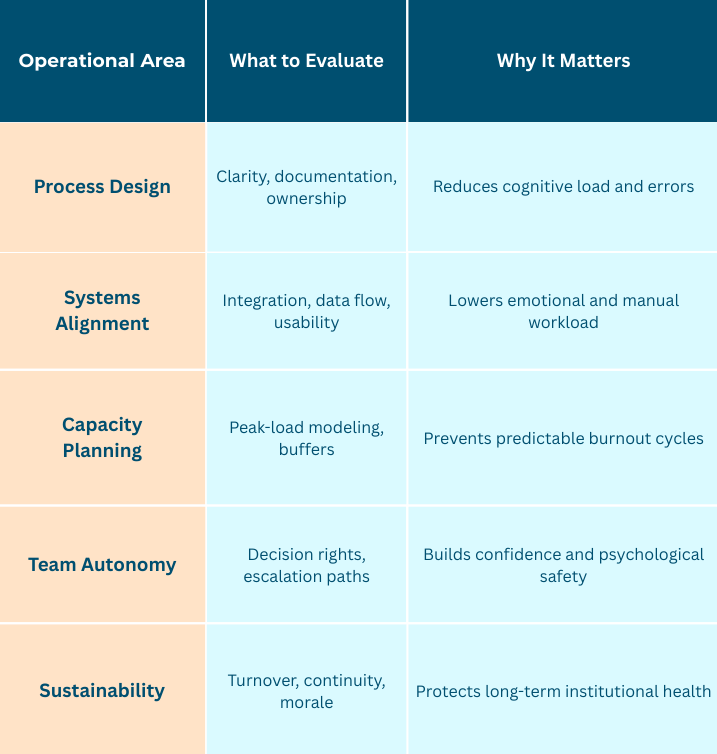
A practical first step:
This week, identify one high-friction process in your operation and map every manual workaround required to complete it, from duplicate data entry to informal escalation paths. Wherever work exists solely to compensate for system or process gaps, burnout risk is already present.
Small operational changes, applied intentionally, can create outsized improvements in morale, sustainability, and service quality.
Final Thoughts
|
Support teams are the connective tissue of higher education. They translate institutional structure into lived student experience. Reducing burnout does not require asking staff to do more, cope better, or be more resilient. It requires designing operations that respect human limits and professional expertise. When systems, processes, and capacity planning are aligned with the realities of the work, morale improves, sustainability increases, and institutions are better equipped to support the students who depend on them. For more information on how we can help you, schedule a meeting with us or contact us at info@edutechloft.com. |