Blog Post
Building a Scalable Student Support Model for Growing Online Programs

Building a Scalable Student Support Model for Growing Online Programs
Higher education is at a crossroads. As of 2024, nearly 25% of all students are enrolled exclusively online, with graduate online enrollment at 45% and projected to reach 55% by 2030. With a global e-learning market growing at 14% annually, institutional growth is no longer about physical campus capacity; it’s about the scalability of your support infrastructure.
Modern students are "discerning, digital, and debt-averse". They expect university services to match the seamless experience of Uber or Netflix. When institutions fall short, they face the "Valley of Death", a gap between student expectations and institutional delivery that leads to disengagement and churn. To survive, universities must transition from "student administration" to "student management," using systems that scale without drowning staff in burnout.
Step 1: Audit Your Current Infrastructure
Don't scale broken processes. Start with a rigorous audit to identify where your systems are buckling under pressure. The goal is to move from being "insight-poor" to "insight-rich" by centralizing fragmented data.
Audit Checklist for Scalability:
- Response Speed: Measure your average inquiry turnaround. A 1-minute response time can improve conversion chances by 391%.
- Digital Stability: Assess VLE stability and library accessibility during enrollment spikes.
- Security Gaps: Perform a privacy audit of support operations to ensure FERPA compliance as you adopt new digital tools.
- Data Integration: Ensure your data follows FAIR principles (Findable, Accessible, Interoperable, Reusable) to avoid siloed information.
- Service "Dead Ends": Map the student journey to find where students are forced to restart inquiries or repeat their stories to multiple offices.
Step 2: Build a Tiered Support Framework
A Multi-Tiered System of Supports (MTSS) allows you to be proactive, matching help to the specific level of student need.
- Tier 1: Universal (75%–90% of students): High-quality core instruction and "Level 0" self-service. This includes searchable campus life portals and automated pathways that empower students to find answers independently.
- Tier 2: Targeted (10%–25% of students): Small-group skill-building, workshops, and peer mentoring for those not responding to Tier 1.
- Tier 3: Intensive (< 10% of students): High-touch, one-on-one counseling and specialized interventions. By automating the lower tiers, you free up experts to focus here.
Evidence shows that moving from teacher-focused seminars to student-centered, activity-driven workshops at Tier 2 can significantly improve retention during student transitions.
Step 3: Leverage Technology as a Multiplier
Don't fall into the "scaling headcount" trap. Instead of hiring more staff for every 100 new students, scale your systems using AI and CRMs.
- AI Chatbots: Virtual assistants typically resolve 60–98% of routine inquiries. In one study, students remained highly receptive to chatbot interactions over four full years, particularly for time-sensitive tasks such as FAFSA renewal and registration.
- Impact on Churn: Universities deploying AI tutoring and 24/7 support report up to a 40% reduction in student churn.
- Efficiency Gains: AI-assisted grading can save 80% of grading time or reduce the burden by over 30%, allowing instructors to focus on mentorship rather than repetitive labor.
- CRMs (The Nervous System): Integrated platforms like Salesforce allow for "holistic advising" by connecting academic, financial, and wellness data into a single view.
Step 4: Train and Align Success Teams for Growth
Scaling technology requires a shift in team structure. You need a "coordinated care model" where advice, financial aid, and wellness teams work in unison.
The ASU Model of Success:
Arizona State University (ASU) moved away from individual staff caseloads to a team-based advising model. Key results included:
- SOS System: Instant collaboration between departments (e.g., financial aid and wellness) to catch students before they drop out.
- 90% Persistence Rate: Fall-to-spring persistence for first-year students exceeded 90%, far above national averages.
- Proactive Outreach: BGSU saw a 4.5% increase in overall retention by shifting from "notification" (sending alerts) to "activation" (human outreach triggered by behavioral data like sudden shifts in dining hall patterns).
Step 5: Measure, Iterate, and Scale
Establish feedback loops and track leading indicators rather than just graduation rates.
Essential KPIs to Track:
- Student Response Time: Target sub-10-minute call-backs (SNHU's model).
- Conversion Rates: Identify where students "drop off" in the application funnel.
- Persistence: Track term-over-term retention and credit accumulation.
- Cost Efficiency: Monitor enrollment growth relative to support staff growth; revenue should scale faster than costs.
Common Mistakes to Avoid
- Siloed Reporting: When departments don't share data, students must repeat their stories, leading to frustration.
- Metric Overload: Don't track everything. Pick 10-12 "winning" KPIs and focus on them.
- Ignoring the "Why": Quantitative data identifies the risk, but qualitative data (surveys/focus groups) explains the root cause.
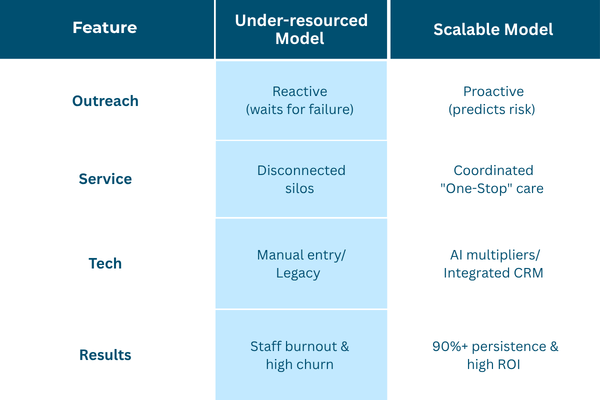
Snapshot: Under-Resourced vs. Scalable Models
The Scalability Blueprint: Merging High-Tech Systems with High-Touch Success
True scalability requires six big shifts: move from compliance-driven to student-centric, from supplier-led to service-led, and from insight-poor to insight-rich. By automating routine tasks and aligning your human teams around high-value interventions, you can ensure that as your institution grows, your students don't just enroll, they succeed.
EDUTECHLoft: Systems That Scale, Success That Lasts
|
EDUTECHLoft Support® bridges the gap between rising enrollment and institutional strain by scaling your systems instead of your staff. We streamlined the entire student journey, from admissions to tech support, ensuring a seamless experience while protecting your team from burnout. Let us transform your operations into a sustainable engine for success. For more information on how we can help you, schedule a meeting with us and discover how we can help your institution grow. |