Blog Post
Student Onboarding in Online Programs: The Missing Retention Lever

Student Onboarding in Online Programs: The Missing Retention Lever
Student attrition in online programs is often treated as an academic problem, but the evidence suggests it begins much earlier, and more emotionally, during onboarding. In this article, we’ll cover why the first 30 to 60 days are the most critical period for retention and how institutions can redesign the student experience to improve persistence, belonging, and long-term success.
The Problem: Online Students Don't Quit Academically, They Quit Emotionally
While administrators often blame academic rigor, students rarely fail out; they opt out. The primary drivers are isolation, confusion, and a mismatch between expectations and reality.
Emotional vs. Academic Drivers:
- Isolation and Disconnection: Students in online environments feel significantly less connected to peers and teachers than those in face-to-face classes. This "relationship tax" increases cognitive load and decreases motivation.
- The Expectation Gap: Online students are more than twice as likely as face-to-face students to drop out because they cannot understand instructor expectations (7% vs. 2.9%).
- Persistence Disparity: Online students quit significantly more often (42.7%) compared to campus students (11.2%).
- Material Quality: 7.9% of online students cite the poor quality of instructional materials as a reason for dropping out, compared to only 1.1% of traditional students.
The Opportunity: The First 30 to 60 Days Are Your Highest-Leverage Window
Early engagement is the strongest predictor of long-term success. If an institution can build "online self-efficacy" within the first month, the student's chances of graduation skyrocket.
Evidence-Based Success Markers:
- Orientation Impact: Completing a mandatory online orientation is often the strongest predictor of first-course success and overall persistence.
- Threshold for Success: Students who complete orientation with a grade of 80% or better show significantly higher retention rates.
- Data-Driven Redesign: By using analytics to identify drop-off points, UMass Amherst achieved:
- 50% reduction in orientation completion time.
- 16% increase in on-time completions.
- 5.3% increase in overall completion rates.

Why Most Online Programs Are Bleeding Students After the First 60 Days
The first 60 days of an online program are a high-stakes battleground where student commitment is either forged or fractured. Despite the growth in digital learning, institutions are struggling to keep the students enrolled.
Statistical Reality:
- The Completion Gap: Online course completion rates are consistently 10% to 20% lower than traditional face-to-face environments.
- The "Cliff Effect": A staggering 70% of students in online courses drop out after only the second week.
- The First-Year Fallout: Nearly 30% of first-year students at four-year universities fail to return for their second year.
- Momentum Loss: Undergraduate online learners attempt an average of 9.53 credits in their first semester but only complete 7.45, a "completion efficiency" of only 78%.
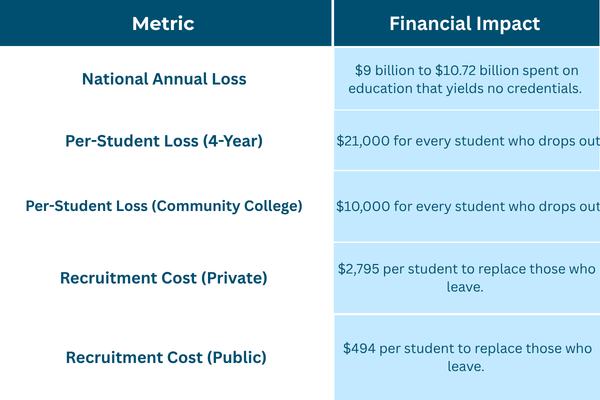
The Financial Cost of Attrition:
What Bad Onboarding Actually Looks Like
Most institutions fall into the "checklist fallacy," treating onboarding as a series of administrative logins rather than a human transition.
Common Gaps in Traditional Strategies:
- Information Tsunami: Inundating students with 2+ hours of content leads to cognitive overload; data shows students lose engagement partway through long modules.
- Response Deficits: When the average time-to-contact exceeds 48 hours, prospects are significantly more likely to abandon the process for a faster-responding competitor.
- Application Abandonment: Complex, non-personalized application paths lead to 40%+ abandonment rates.
- IT Focus Only: Treating onboarding as a password and URL checklist ignores the student's emotional need for "voice" and "presence".
What Great Onboarding Looks Like: Building Belonging
Great onboarding prioritizes human connection and cultural immersion before the first academic assignment is even due.
The "High-Touch" Roadmap:
- Week Zero Activities: Inviting students to "play" or engage in social games and forums before classes start to build early socialization.
- Onboarding Buddies: Pairing new students with experienced mentors or peers. These "buddies" meet with students daily at first, then weekly, to provide emotional and social support.
- Visible Teaching Presence: Using instructor introduction videos and "Show Me How" tutorials to establish an approachable authority figure early on.
- The Whole-Family Approach: Engaging the student's family as "strategic partners" to reduce home-based anxiety and build a support network outside the LMS.
Common Mistakes to Avoid
- Stopping Early: Assuming onboarding ends on Day 1. It is a 60-day lifecycle requiring regular check-ins and proactive outreach for non-participation.
- Ignoring Life Context: Adult learners prioritize flexibility and career alignment; generic orientations that don't address work-life balance often lead to withdrawal.
- Lacking Technical Training: While social connection is the top retention driver, the most frequently cited weakness in orientation is a lack of actual technical training on the software.
Your Onboarding Is Either Building Retention or Destroying It
Higher education leaders should treat the first 60 days as a key retention window. A proactive, student-centered onboarding strategy can strengthen persistence by supporting time management, faculty presence, belonging, personalized support, and engagement. When done well, onboarding improves student success and institutional strength.
EDUTECHLoft: Your Strategic Partner in Improving the Student Lifecycle Journey
|
EDUTECHLoft helps institutions strengthen the student journey by improving the first 60 days of onboarding and building trust at every touchpoint. Through learner-centered design, proactive support, and streamlined processes, we help create a stronger foundation for retention and long-term growth. For more information on how we can help you, schedule a meeting with us and discover how we can help your institution grow! |